Teamsters Local 492
Teamsters Local 492
 

×
Register an Account
Forgot Login?

Drivers Seek Better Benefits, Strong Retirement, Fair Work Rules

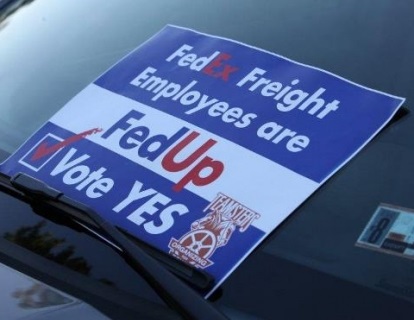
The fight and long-term Teamster commitment to organize workers at FedEx Freight and to win first contracts moves forward, and the drivers are committed to keeping up the pressure in their quest for justice at their workplace.

“The main thing we’re fighting is corporate greed,” said Mel Mendieta, who has worked as a city driver at FedEx Freight for more than 25 years. “The company was cutting our benefits and our retirement security is lousy. We needed to form our union to gain our voice and help rebuild the middle class.”

In 2015, Mendieta and 49 of his co-workers voted to join Local 439 in Stockton, Calif. Like FedEx Freight workers who also made Teamster history by voting to join the union at three other locations, they are remaining positive and fighting to win their first contract. The contract fight is now in court and with the NLRB.

The Teamsters are making progress at both FedEx Freight and at Con-way Freight, with organizing, firstever national days of action at both companies, nationwide engagement and interaction with the workers and the bargaining process that’s under way. The union has also filed unfair labor practices charges, is involved with federal court cases, is building nationwide activist committees, is conducting freight member organizing trainings, launching shareholder resolutions and other ongoing steps.

A Long-Term Effort

“I’ve said it before and I’ll say it again, the campaigns to build Teamster power at FedEx Freight and Con-way are not sprints, they are marathons,” said Tyson Johnson, Director of the Teamsters National Freight Division. “We are committed long-term to this fight so that FedEx Freight and Con-way workers will have an opportunity to enjoy a more secure future as Teamsters.”

Carter Marshall, a road driver at FedEx Freight near Chicago, said he wants to form a union with the Teamsters so that he and his co-workers can fight for better health care and retirement, and consistent work rules.

“The work rules are constantly changing and you don’t know from one day to the next what you need to do,” Marshall said. “It makes the job very difficult.”

In Charlotte, N.C. where FedEx Freight workers joined Local 71, they are also in court trying to get the company to bargain fairly for a contract.

“We’re dropping anchor and getting ready for the long-term fight,” said Patrick Harrington, a road driver at FedEx Freight in Charlotte. “We appreciate all the support from Teamster freight members.”

Although workers don’t yet have a contract, Harrington said conditions have improved dramatically.

“We have more job security in Charlotte since forming our union,” he said. “It’s a night and day difference. I’m ecstatic. We’re getting stronger.”

Already Successful

The Teamsters’ campaign has already raised standards for workers at both companies. For example, Con-way has spent more than $60 million on pay raises since the campaign began, in addition to the big money it has spent on union busting.

FedEx Freight raised wages at some facilities by as much as $4 per hour and almost 10 cents a mile in compensation, which includes a company-first 90-cent across-the-board increase last October. It has also held the employees’ costs for health care static for the first time in more than a decade. The union estimates that the company has spent nearly $300 million this past year on pay raises, benefits and union busting tactics.

Raising standards in the freight industry through the Teamsters’ efforts is an important factor which helps the FedEx Freight and Con-way workers directly. The union’s efforts also indirectly help all freight industry workers, including our Teamster freight membership.

Mendieta said he hopes other FedEx Freight workers will research how the company’s corporate greed is hurting them. “The company is full of spin and deception,” he said.

Workers are not giving up and they appreciate the support that Teamsters are providing. “

Our fight will continue,” he said. “It’s an uphill battle but there’s strength in numbers.”

Click Here To Read More About the FedEx Freight and XPO/Conway Organizing Campaigns  


Download: FedEx Conway Leader Article.pdf

On March 7, 2016, a federal appeals court enforced a decision of the National Labor Relations Board and ordered FedEx Freight to recognize and bargain with Teamster Local 71 in Charlotte, N.C. and Local 107 in Philadelphia, where members in separate elections had voted to join the Teamsters.   FedEx Freight had refused to recognize the NLRB’s bargaining unit determinations and the resulting union election victories. This decision is a major win for Teamsters at FedEx Freight! Read the latest decisions in the case.

FedEx Freight Employees Demand Bargaining Now

FedEx Freight workers who have joined the Teamsters are fighting for fair contracts and they are asking their co-workers at FedEx Freight to fill out a petition demanding that the company bargain with the union. Click Here to sign petition. 


We had a big night in Santa Fe! Thank you to everyone who came out today and has helped us along the way. It's really been a team effort. Here is the update: 

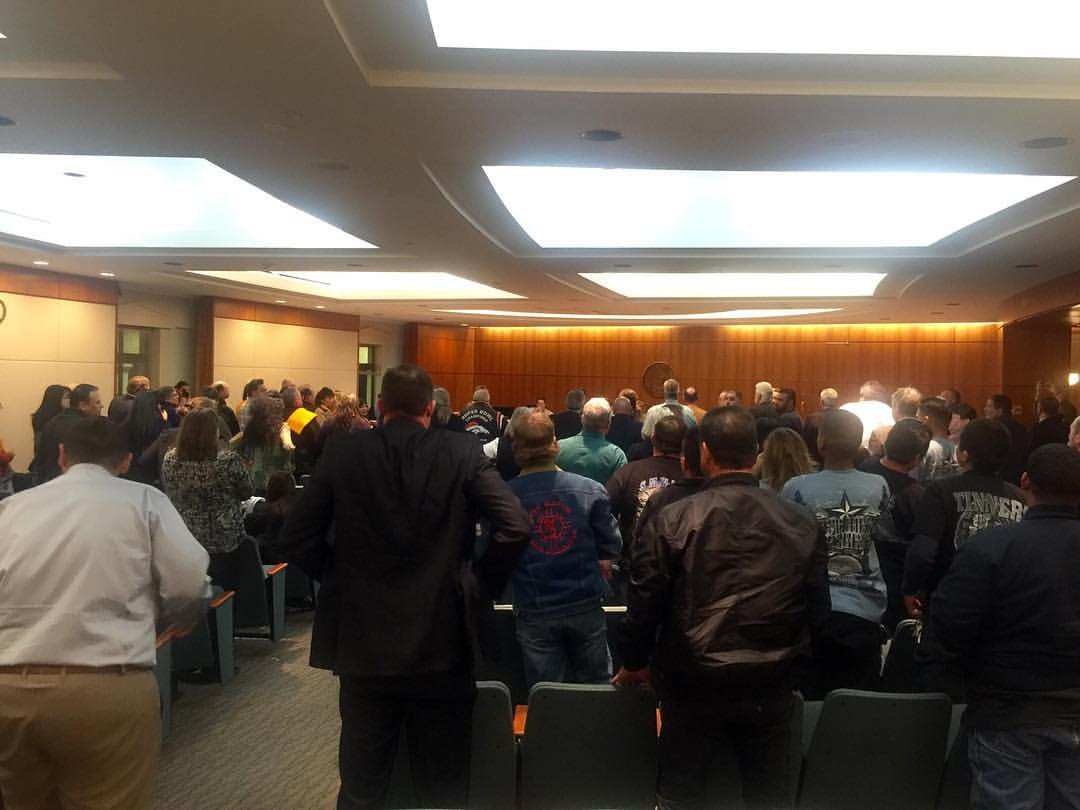
Right to Work: The Senate Public Affairs Committee (SPAC) heard SB 269, The Employee Preference Act (aka right to work) on Tuesday night. When the committee chair asked that everyone in the room opposed to the RTW bill to stand, the whole room stood up! Attached is a picture of the opposition to RTW standing in front of the committee. It's amazing! 
Each side had 6 people speak to the committee about the effects of the bill. The first opposition speaker was Tim Crone from AFT. He delivered to the Committee the 4000 petition signatures we had gathered. The committee voted to table the bill (5-4). This essentially kills the bill. The fight isn't completely over yet, but this was a great night. 
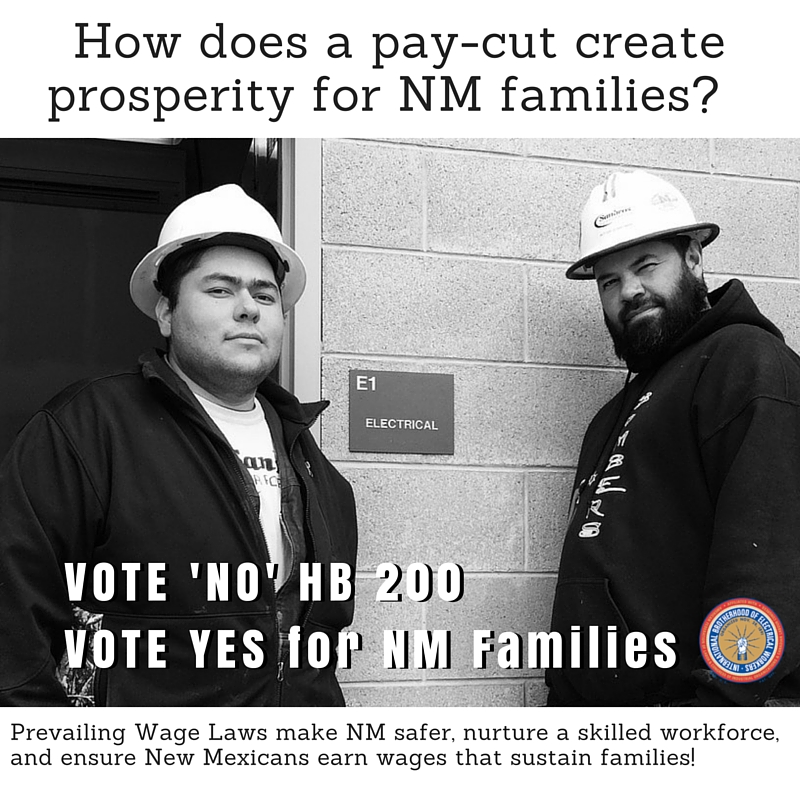
Prevailing Wage: A bad prevailing wage bill, HB200, passed the House (35-32) mostly along party lines and is headed to the Senate. 
Lobby Day: UFCW had a lobby day today. They also delivered 112 letters from Working America to Senator Barela who is the newest member of the SPAC. Thank you letters where also delivered to Senator Campos. 

New Mexico had one of the highest unemployment rates in the nation in recent months. You’d think that Gov. Susana Martinez and state legislators would focus on getting New Mexicans back to work and protecting good jobs.

But they’re doing just the opposite. This week, the state House began debate on a bill that would eliminate prevailing wage laws for construction workers. This bill will lower the wages of hardworking New Mexicans, make it easier for construction companies to hire out-of-state workers for taxpayer-funded projects and make our schools, bridges and roads less safe and cost more.

The New Mexico House is expected to pass this bill, but we think we have a good shot at stopping it from moving out of the state Senate.

Send an email to your senator today and ask them to vote against any bill that would eliminate prevailing wage laws.

This one is pretty simple. Prevailing wage laws help to ensure that local workers, whose families shop and support local businesses in our communities, are hired to build our schools, bridges and other taxpayer-funded projects.

But if these laws are repealed, less-skilled, out-of-state construction workers will be brought in to do this work, which won’t save our communities any money—in many cases, it costs more—because they won’t be getting the job done right the first time. Also, having less-skilled workers do these jobs would make the schools, bridges and roads we use every day less safe.

That’s not what our families and working people deserve.

Contact your senator today and ask them to protect existing prevailing wage laws.


Susana Martinez and other politicians in Santa Fe have made it clear they want to pass an unfair and unnecessary “right to work” bill this legislative session. This legislation would silence the professional voices of workers including Teamsters, teachers, nurses, firefighters and police officers and cut pay and benefits for even non-union New Mexico workers.

Sign This Petition Now By Clicking Here to tell legislators in Santa Fe to vote no on right to work! 

SB 269 is scheduled for a hearing in Senate Public Affairs Committee (SPAC) on Tuesday afternoon/evening. The committee meeting starts at 1:30pm (or 30 min post floor session) in room 321. We don't have an exact time that they will get to SB 269, but we expect this will be a long, late hearing. There are a lot of contentious bills on the committee calendar for Tuesday. Please plan to join us if you can. 

WHAT: Senate Public Affairs Committee Vote on SB296, so-called “right to work” bill 
WHERE: NM State Capitol, Room 321 
WHEN: Tuesday, February 9th at 1:30 PM*

If folks aren’t able to make it in person tomorrow, they can help spread the word and share our petition calling on the legislature to reject this deceptive and unnecessary bill!


House Bill 200 an Attack on Good Wages and #WrongforNM

Workers Are Under Attack!

The same powerful interests pushing Right-to-Work are attacking Prevailing Wage protections in state law.


House Bill 200 is scheduled in the House Business & Employment Committee THIS THURSDAY, January 28 at 8:30 AM in Room 307.

Call your NM Legislator today! Click Here to find your Legislator info

CLICK HERE for Info Sheet on The Importance of Prevailing Wage!

CLICK HERE for HB200 Talking Points

This is the ONLY committee hearing for HB 200 in the House, so please come out to oppose the bill and testify in support of working New Mexicans!


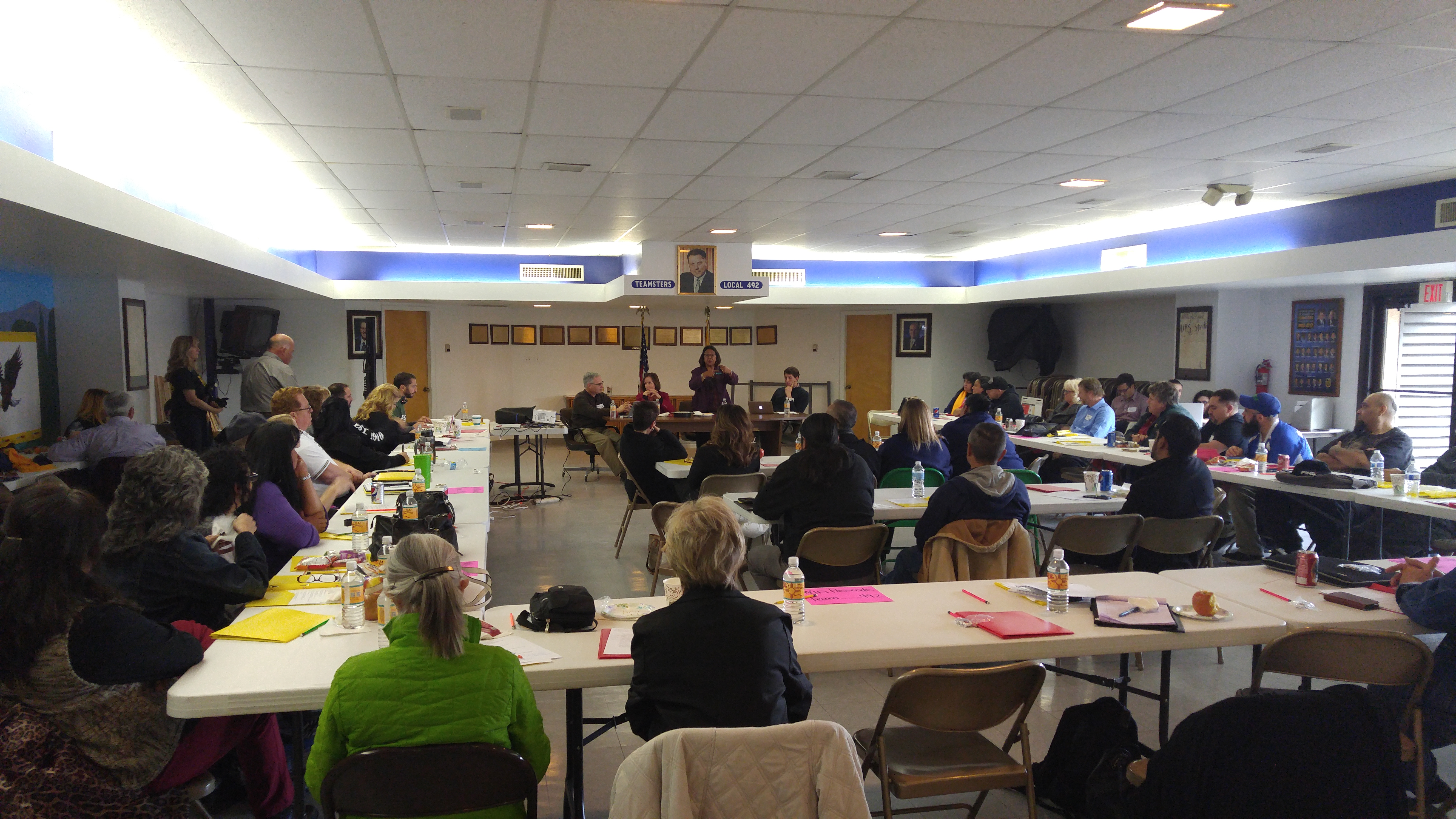
On January 8th & 9th Teamsters Local 492 hosted a 2016 Legislative Session training day for 8 NM Unions, over 100 Union Members showed up to learn about the upcoming fight to keep anti-worker legislation out of New Mexico. Unions from across NM attended including AFT, AFSCME, IATSE, IAM, IBEW, IBT, NEA, & UFCW.

These members learned the real reason RTW and other anti-worker bills are actually be pushed in NM and why out-of-state organizations like ALEC are pressuring local legislators to pass these bills they have created.

Speakers of note were State Senator Mimi Stewart and Rep Patricia Roybal Caballero who discussed the importance of getting involved and reaching out to your legislators to let them know you are against anti-worker bills like RTW.

On behalf of everyone that attended, Teamsters Local 492 would like to thank Michelle Mayorga &  Chelsey Evans for organizing the event. 

To Read More about RTW and why it is bad for workers, Click Here.


10-Hour OSHA/3-Hour Hazcom

Or Forklift Safety Certification

2016 Training Schedule

This year Operating Engineers Local 953 is allowing 492 Teamster Members to attend their training in order to offer our members several opportunities to be trained, at no cost to you. 

January 16, 2016    Forklift Safety Certification   8:00am   *ABQ Training site

February 6, 2016   Forklift Safety Certification   8:00am   **Kirtland NM Hall

March 5 & 6   10-Hour OSHA/3-Hour Hazcom   8:00am   *ABQ Training site

(6-Hours Saturday/4-Hours Sunday)

April 23 & 24     10-Hour OSHA/3-Hour Hazcom   8:00am   **Espanola

(6-Hours Saturday/4-Hours Sunday)

May 7 & 8   10-Hour OSHA/3-Hour Hazcom   8:00am   **Kirtland NM Hall

(6-Hours Saturday/4-Hours Sunday)

July 23, 2016    Forklift Safety Certification   8:00am   *ABQ Training site

August 27 & 28   10-Hour OSHA/3-Hour Hazcom   8:00am   **Espanola

(6-Hours Saturday/4-Hours Sunday)

October 8, 2016   Forklift Safety Certification   8:00am   **Kirtland NM Hall

Please direct all questions about these classes to Thomas Islas

 **For Location information contact the Training Director;

Thomas Islas @ 505-877-5071, Toll Free @ 866-855-8842

 Email: thomaslocal953@gmail.com

*ABQ Training site is located at: 3508 Los Picaros RD. S.E. Albuquerque NM 87119

**Kirtland NM & Espanola NM Training site contact Thomas Islas

Click here to download the Notice


Download: OSHA-Hazcom & Forklift 2016 Training Schedule.pdf

Applications for the 2016-2017 Academic year of The James R. Hoffa Memorial Scholarship Fund Application deadline March 31, 2016 are now available at the Teamsters Local 492 office or you can  Click Here for Application Forms.

The James R. Hoffa Memorial Scholarship Fund awards scholarships annually to outstanding high school seniors.  All applicants must comply with the following eligibility and application criteria.

Each applicant must:

  1. Be the son, daughter, or financial dependent of a Teamster member (hereafter also referred to as “Teamster Member Relation”) who qualifies (or in the case of retirees, has qualified)* as a member in “good standing” in the Teamsters Union per Article X, Section 5 of the International Constitution;
  2. Be in his/her last year of high school and may not apply if he/she has already graduated from high school;
  3. Be in the top 15% of his/her high school class;
  4. Plan to submit excellent SAT or ACT scores for evaluation (U.S. only);
  5. Plan to attend an accredited four-year college or university within the United States or Canada, as a full-time student.  Those who plan to attend non-academic or certificate programs or community college, may not apply.

Materials will be sent to every local union in the US and Canada, but if you would like to download the materials, you can  Click Here for Application Forms

Scholarship applicants compete in one of the five geographic regions where the Teamster Member Relation’s Teamsters Union affiliate is located. One category of awards totals $10,000 each. These four-year scholarships are disbursed at the rate of $2,500 per year and are renewable annually. Other awards are one-time $1,000 grants. These scholarships are disbursed to the college or university at the beginning of the recipient’s freshman year.

Eligibility requirements and application procedures are the same for all awards. Recipients are selected by an impartial committee of university admissions and financial aid directors based on academic achievement, SAT/ACT scores, character, potential, and financial need. We consider all applicants without regard to race, religion, gender, disability, or any other legally protected status.

 Click Here for Application Forms

Arguing Economics at the Dinner Table (Update)

By Josh Bivens

Last Thanksgiving I wrote a blog post in the “how to argue with your relatives at Thanksgiving” genre, providing some hard numbers for people who didn’t want to let their conservative relatives spout nonsense about economics with impunity at the holiday dinner table. This year, lots of those same arguments are still in the news, so I updated some of the data and points for 2015. Also, another silly argument seems to be making the rounds: the claim that the Fed’s low interest rates have somehow hurt “poor savers,” and hence the Fed should raise rates at its next meeting.

So, here’s an updated list of some of the myths that come up every year, and how to address them.

MYTH: The government’s spending too much—they should tighten their belts the same way households had to following the Great Recession

This “tighten the belts” line is perhaps the worst analogy ever. And yes, it’s bipartisan silliness. Simply put, if everybody (households, businesses, and governments) tightens their belts together (i.e., stops spending money) then the result is just a steep recession. Even with increased federal government spending, tightened household and business spending in 2008-2009 led to a savage economic downturn. Actively cutting government spending would’ve made it worse. Much worse. There really is tons of evidence that the increases in government spending during and right after the Great Recession (the Recovery Act, mostly) made the recession much lighter and the recovery come faster.

But, say you continue to disbelieve the overwhelming evidence that spending cuts slow growth and worsen recessions. Let’s just look at the data on federal spending in the recovery since the Great Recession versus recovery from the previous three recessions (in the early 1980s, early 1990s, and early 2000s) to see if even the premise of “exploding spending” in recent years is right. The figure below shows (inflation adjusted) federal government spending over the full business cycle (centered on the recession’s trough in the middle of 2009.

Notice anything? Yeah, recovery from the Great Recession has been associated with the most austere spending following a recession in decades. And this weak spending is, by the way, the entire reason why recovery has been so slow to come. Put it really bluntly: if federal spending under the Obama administration had risen at the same rate as it did during these previous recoveries—yes, even the one during the Reagan administration—we’d have between $440-890 billion more in federal spending today, and we’d be at full employment.

MYTH: Boosting job growth and wages means getting the government off our backs: we need to cut taxes and get rid of regulations

Yes, this is smuggling in two bad arguments under one title. But while taxes and regulations are different, the theme of “heavy-handed government is holding back growth” is the same. And it’s pretty easy to demonstrate that neither is a candidate for having smothered incentives or business profitability in recent years.

Look below at the figure showing overall federal tax rates for the middle three-fifths (call them the broad middle-class) of American households since 1979. Most of the tax share for these households is actually payroll taxes—the federal income tax share for this group is almost trivially small. There are two things to note in the chart below.

First, contra Mitt Romney, middle class Americans pay taxes—there is no 47 percent here that pay nothing.

Second, taxes for this broad middle class are down a lot over the last decade (note, taxes for the very rich are down a lot as well), and the decline has been steady. Tax rates for this group in 2013 are lower than in 1979, 1989, or 2007. For the middle-fifth of American households, the overall effective federal tax rate is down by more than 40 percent since 1979. And these tax rates even include the employer side of payroll taxes, so the actual tax rates calculated by most households (who might only include the payroll taxes they directly pay) are quite a bit lower.

Meanwhile, the only economic story for how regulation could be holding back the economy that makes any sense is if a clear increase in the scale of regulatory reach had severely damaged the profitability of business, killing their incentive to produce and hire. It would be awfully hard to make the claim that we’re regulating businesses to death if, say, U.S. corporations were experiencing some of the highest profit rates ever. Hard, but that does seem to be the story that the anti-regulation crowd is sticking to. The figure below shows profit rates for the U.S. corporate sector over time. The regulatory strangling of business in recent years is very hard to see here. But feel free to squint away.

MYTH: Raising the minimum wage will just make everything cost more and do other associated bad things

It used to be that arguments against raising the minimum wage centered on job loss for precisely the workers that minimum wage increases were supposed to help. One was supposed to be stunned by the sad irony of it, I guess. But researchers have looked hard to see if minimum wage increases really do cause job-loss in the real-world (and not just in introductory economics textbooks). And they don’t.

So now that the job loss argument has been largely defanged, one often hears claims that raising minimum wages will just boost prices, thereby hurting the living standards of precisely the workers that minimum wage increases were supposed to help. Ah, the sad irony again.

There are two responses to this “it will just cause inflation” argument against raising minimum wages.

First, it is actually true that raising the wage of any group of workers will likely put upward pressure on the stuff that these workers produce. So, an increase in the minimum wage could raise prices in, say, the fast food sector. But it’s odd how this same logic doesn’t make people decide that we should push back on policy decisions that raise wages for highly-paid workers. When the people who argue that minimum wage increases will just raise prices see CEO pay exploding because of poor corporate governance and tax policy, do they generally argue that that will raise prices? Or when they see the warnings at the beginning of DVDs against making copies for commercial resale under penalty of criminal prosecution, do they say “hey, that increases prices?”

They should, because these policies do raise prices and hurt the purchasing power of non-CEOs and those who don’t earn income from copyrights. And yet CEOs and owners of entertainment companies still seem to think these are good policies from their point of view. So, low wage workers should absolutely see efforts to raise the minimum wage as useful even if they do put upward pressure on prices.

This reasoning leads to our second point: the wage increase spurred by a higher minimum wage will absolutely dwarf any potential impact on prices for the living standards of affected workers. Take the increase in wage income estimated to be generated by an increase in the federal minimum wage to $10.10 by 2016—roughly $35 billion. Divide this by the total amount spent on consumption goods in the U.S. economy (about $12 trillion) to get a sense of how much this will raise prices in the economy—0.3 percent. To be clear, this does not mean a 0.3 percent increase in inflation, it means a one-time 0.3 percent increase in prices. So, basically a 0.1 percent increase in inflation for 3 years and then dropping back to zero.

Meanwhile, the typical worker affected by the proposed $10.10 increase would see (roughly) a 20 percent raise in hourly pay. And even if the entirety of the minimum wage increase was financed simply by higher prices (it won’t be), then this worker is still much, much better off.

John Schmitt from the Center for Economic and Policy Research has a great paper the sums up lots of this—showing why lots of things (not just prices or jobs) can change in response to a minimum wage increase, including productivity and profit margins.

MYTH: The real problem with today’s economy is workers don’t have the right skills to keep pace with technology.

This one is very widespread and very hard to address seriously in just a few sentences. But, some observations.

First, an appeal to authority. People who have looked very carefully at the evidence here find very little to suggest that demand for high-skilled workers has outpaced their supply and that this gap has driven inequality in wage growth in recent years.

Second, even seven years after the start of the Great Recession, there remain two unemployed workers (and more if you count “missing workers”) for each job opening. Today’s excessively high unemployment (and too-low labor force participation) remains mostly a general job availability problem and not a reflection of any “skills mismatch.”

Third, inflation-adjusted wages—even for workers with a four year college degree—have been flat for over a decade. This doesn’t look like an economy rewarding skill per se. Instead it seems to be rewarding a very narrow slice at the top.

Fourth, since the start of the recession at the end of 2007, more than half of all income gains in the corporate sector have gone to capital owners instead of workers (capital owners have generally claimed well under a quarter of total income gains over the past six decades). Unless one is changing the definition of “skilled” to mean “already owning lots of wealth,” it’s hard to see what skills have to do with this.

Finally, many people point to the recent decade’s obvious technological advances as evidence that the economy has been changed in a way that can’t provide decent living standards to many workers. This is far from clear. After all, technology changes all the time. In fact, the way economists measure technological change, the amount of goods and services that can be produced in an hour of work, actually shows more rapid technological change in the 30 years after World War II—a period of much more egalitarian economic growth.

Explanations for economic changes based on technological change always sound convincing, for a simple reason: At any point over the past century you could have walked into a factory and been told about the big technological improvements that had been made over the past decade. If you’re a business writer who walks into a factory today looking for a root cause of the labor market’s doldrums, guess what? You’ll be told about the big technological improvements made over the past few years, and then you might think, “Hey, that’s why the jobs aren’t here and why wages are flat!” But, if you had walked into a factory in 2000—when the unemployment rate reached 3.8 percent—you also would’ve been told about an amazing decade of technological advancements. And you might think “hey, that’s why things are going so well!”

Technology is always advancing, but it does not have to consistently damage most American’s living standards. The reason American workers haven’t been doing well for most of the past three decades is rooted in policy, not technology.

MYTH: Unions haven’t done anything for us

It is often noted that the rise in American inequality and the beginning of the era of what some have called the Great Wage Slowdown is correlated with the declining share of American workers represented by a union.

Yet few people seem to consider this decline in worker representation the outcome of apolicydecision. Instead they shrug and decide that unions aren’t modern or aren’t suited for the new economy (however you decide to define that). Yet advanced countries around the world, with economies as productive (or more) than ours, have much higher rates of unionization. The share of workers that wanted to be represented by a union before the Great Recession had reached historic highs, even while the share that were in unions reached historic lows. It’s hard to imagine that policy decisions aren’t playing a role in that growing wedge.

And clearly policy has not kept pace with growing employer hostility to unions or kept the playing field level between employers and workers wanting to join a union—as shown by the increased pace of illegal firings of union organizers in recent decades.

Why should today’s workers care whether or not unions thrive or decline? Tom Edsall raised a good point recently in this regard: those who hate unions sure think policy matters. Every chance they get, advocates for the already-rich fight tooth and nail to not just contain, but roll back workers’ ability to bargain collectively.

And in purely self-interested terms they’re right. Unions do not damage productivity or employment growth, but they do distribute income gains more equitably between corporate managers/capital owners and workers. And the gains to workers spurred by unionization do not just accrue to union members. When they have power they set standards which spill over into higher wages and better compensation even for non-union workers. Below is an updated chart first made by Colin Gordon showing the long-run relationship between unionization and top income shares. 

So it makes perfect sense for those invested in the economic wellbeing of highly-paid corporate managers and capital owners to hate unions. What makes much less sense is that too many of the rest of us don’t seem to appreciate what they do.

MYTH: By keeping interest rates low, the Federal Reserve hurts “poor savers”

I should start by noting that the whole idea of “poor savers” is odd. Genuinely asset-poor households tend to be net borrowers, not net savers. Net borrowers are hurt—and hurt a lot—when inflation comes in below expectations. Think about a mortgage which comes with a fixed monthly payment of $1,500 per month. When you take out a mortgage, a key variable for how affordable it will be over the life of the loan is what you forecast for the rate of inflation over that time. Say that you made the common-sense assumption that the Fed will meet its 2 percent inflation target in coming years. This means you counted on your monthly payment getting cheaper (by 2 percent) in price-adjusted terms every year over the life of your mortgage. If inflation instead comes in well below this target (the way it has in recent years), then the inflation-adjusted burden of your mortgage erodes much more slowly, and your mortgage has become less affordable.

So, how can the Fed insure that they actually meet their inflation target and help net borrowers? Keep rates low.

Moreover, for those who really do have significant net savings (we should probably tend to refer to them as “wealthy,” by the way), it is true that rates of return on their savings (mostly held as government bonds or private sector stocks and bonds) have been low in recent years. But the arithmetic and the economics of assets and rates of return is clear that low rates of return on assets are essentially always and everywhere associated with high prices for these assets. Take a bond that will pay off $110 in one year. If the price one must pay to obtain this bond today is $100, then the rate of return is 10 percent. If the price one must pay to obtain this bond today rises to $105, then the rate of return falls to (just under) 5 percent.

Yes, it gets more complicated than this pretty quickly, but the fundamental insight remains that rates of return are low today because assets are so expensive. Given this, it is very had to take complaints from significant net savers seriously, when they are essentially complaining that their assets are so valuable (and they themselves are so wealthy today) that rates of return going forward won’t be particularly high.

So, what about “poor savers” who have all their net worth in a cash account (i.e., not stocks or bonds)? Aren’t they hurt by low rates? Conceivably—but nobody with significant assets (say more than $5,000) holds them all in cash. And for $5,000 in cash, the difference between 3 percent returns and zero is about $150. Not nothing, but compare these losses relative to the broader damage done by higher rates and it’s still an awfully weak argument.

Finally, and most importantly, the most important transmission mechanism from Fed interest rate policy to income distribution comes though the labor market. Because low interest rates boost economic growth and lower unemployment, they boost wages for workers—and these wage boosts are most pronounced for low- and moderate-wage workers. These labor market effects swamp the effects on asset prices for the vast majority of Americans, because income for most American households is dominated by their weekly paychecks, rather than what they earn from asset holdings.

News:  Prev Next  
-
Teamsters Local 492
4269 Balloon Park Road NE
Albuquerque, New Mexico 87109
  505-344-1925

Top of Page image
Powered By UnionActive - Copyright © 2026. All Rights Reserved.