| |
|

March 1st, 2013
The Union and ABF have adjourned for the week and will be back at the table on March 11, 2013. Plans are for a week of talks then one week off and then back again on March 25th to hopefully wrap up the contract even if it means working through the Easter Sunday weekend to get it done.
Progress has been made over the month of February and the momentum is there for a deal to get done. The IBT also released This statement today Click Here.
Click here for the ABF Updates Page
|
Download:
 ABFUpdateMarch12013.pdf ABFUpdateMarch12013.pdf
|
|
| |
|
March 1st, 2013
The Union and ABF have adjourned for the week and will be back at the table on March 11, 2013. Plans are for a week of talks then one week off and then back again on March 25th to hopefully wrap up the contract even if it means working through the Easter Sunday weekend to get it done.
Progress has been made over the month of February and the momentum is there for a deal to get done. The IBT also released This statement today Click Here.
Click here for the ABF Updates Page
March 4th Update- ABF Press Release:
(March 4, 2013) Following the conclusion of last week’s round of negotiations in Kansas City, ABF is pleased to report progress on various operational flexibility issues that will allow us to better serve our customers in a marketplace that continues to undergo significant change. Through hard bargaining on both sides of the table, we are comprehensively addressing the first set of substantive issues on various operational needs to help ABF better compete. Work on those operational issues continues and we look forward to continued discussions in the coming weeks on specific economic terms that remain.
Based upon the current state of negotiations and progress that has been made so far, ABF expects that good faith negotiations could, if necessary, continue – as required by federal labor law – beyond March 31, when the current collective bargaining agreement expires. The company anticipates that an extension would be possible as long as the two sides continue to make progress at the negotiating table. It is important to note that in this circumstance, the existing superior wages and benefits enjoyed by ABF Teamster employees would remain in place during the extension period.
In this process, we seek to appropriately lower our cost structure and better serve customers while still maintaining some of the best jobs in the LTL industry and protecting our employees’ retirements. We wish to thank our dedicated employees for their continued hard work and outstanding service to our customers while this important process continues.
We will provide additional updates as negotiations continue and wish to assure all of our customers that ABF’s employees will continue to deliver the highest quality of service that our customers have come to expect. Negotiations resume in Kansas City the week of March 11.
|
|
|
| |
|

The Western Conference of Teamsters Pension Plan was established in 1955 through collective bargaining between labor and management.
Today your Plan is the largest area-wide multiemployer pension plan in the United States. It covers more than 230,000 active participants through pension agreements negotiated by Teamster local unions with about 5,200 employers in 13 Western states.
Over its more than 50 years of existence, the Western Conference has provided substantial, secure retirement benefits to more than 600,000 retirees and survivors. In 2012, the Western Conference served over 375,000 active and inactive vested participants and over 205,000 retirees, with participants or retirees located in every State. Almost 1,700 employers contribute to the Western Conference, including numerous small businesses. These employers represent more than 50 diverse industries—including grocery and food distribution, package delivery, manufacturing, clerical, beverage bottling, law enforcement, entertainment, waste disposal, and health care. Almost three-quarters of the contributing employers have fewer than 50 employees.
The Western Conference remains a well-funded pension plan and has been certified in the Green Zone every year since the PPA first created the zone ranking system for plan funding. Read a recent mailing that gives estimates of how the fund is currently doing by clicking here.
Here are some of the major industries with contributing employers:
|
Aerospace
Airlines
Appliances
Automotive
Bakery
Bottling
Brewery
Building Materials
Bus Drivers
Car Parking
Casinos
Construction
Convention Services
Dairy
Feed and Grain
Frozen Storage
|
Electronic Media
Food Processing
Freight and Package Delivery
Funeral
Furniture
Glass & Paint
Grocery
Hospitality
Industrial Trades
Janitorial
Laundry Services
Lumber & Paper
Manufacturing
Medical
Motion Picture & Theater
Municipal Transportation
|
Natural Resources
Newspapers & Magazines
Office
Public & Professional Employees
Racetrack
Recycling and Waste Management
Retail
Sand & Gravel
Sanitation
Taxi & Limo
Transportation
Van and Storage
Vineyards
Waste Management
Wholesale Supply
|
|
|
|
| |
|
Read the latest from unions in the Rocky Mountains Here.
|
|
|
| |
|
February 1st, 2013 - Negotiations adjourned by mutual agreement on Thursday, January 31, and will resume as scheduled on February 12. While no substantive progress can be reported at this time, the parties have shared detailed information that will hopefully advance the dialogue in the weeks to come.
The Teamsters National Freight Industry Negotiating Committee (TNFINC) is carefully reviewing that information as well as the company’s year-end financial report as discussed on an investor conference call on Wednesday, January 30.
“It is our desire to reach a mutually beneficial collective bargaining agreement with ABF and we are carefully reviewing the information provided by the company,” said Gordon Sweeton, Co-Chairman of TNFINC. “Be assured, however, that we remain steadfastly committed to protecting good Teamster jobs and benefits.”
To View/Download the Feb 1st IBT Mailer, Click Here.
For all the updates and history of the ABF talks Click Here
Below is a recent history of updates on these negotiations:
Jan 17th 2013 - Negotiations were recessed on Wednesday afternoon. Progress has been proceeding very slowly. The Company continues to seek to undo 50 years of bargaining history and completely rewrite the current agreement by insisting on removing the supplements.
The Company claims that it needs the labor cost savings reflected in its proposal which includes but is not limited to part-timers, split-shifts, and increased use of subcontractors, working across classifications, reduced vacations, and reduction of holidays and the elimination of all supplements. TNFINC has been questioning the purpose and scope of the Company’s proposal. In this regard, TNFINC pointed out that if the Company was truly serious it would have the specific cost savings associated with each of its proposals readily available.
The Company, however, was unable to provide the information and says it will try to provide the information when negotiations resume on January 28. According to TNFINC Co-Chairman Gordon Sweeton “the failure of the Company to have the cost analysis of its specific proposals at its fingertips strongly suggests that the Company was not prepared to engage in legitimate bargaining and that its proposal is simply an overreaching effort designed to bludgeon worker rights.”
In an earlier statement on January 11th, Gordon Sweeton, Co-Chairman of the National ABF Negotiating Committee for TNFINC also said, “We had a rough start this week due to major differences on important issues, but we are hopeful we will make progress in the near future.”
Negotiations will resume next week and are scheduled into March, a full schedule is noted at the bottom of this article. The Teamsters National Freight Industry Negotiating Committee (TNFINC) began negotiations with ABF Tuesday, January 8 in Kansas City, Missouri.
On December 19, TNFINC exchanged national and supplemental contract proposals with ABF. “The union is disappointed with ABF’s initial contract proposals that seek to destroy the NMFA (National Master Freight Agreement) standards that have been in effect for decades and served ABF well,” said Gordon Sweeton, Co-Chairman of the National ABF Negotiating Committee for TNFINC on December 20th. “We hope the company will bargain in a traditional manner so that we can make progress on the important issues from the start,” Sweeton said. “The poor state of the economy over the past four years created losses at all large LTL companies and the labor-intensive type of freight operations ABF conducts are issues as well,” Sweeton added. “As for pensions, the company’s pension costs in its largest fund, the Central States, have been frozen the past two years with health and welfare costs only seeing modest increases during that time as well.”
The current contract expires March 31 for the 7,500 drivers, dockworkers, mechanics and clerical staff. On November 29, leaders from local ABF unions unanimously approved the Teamster’s contract proposals.
The ABF Contract Negotiations Time Table is as follows:
There will 3 straight full weeks of negotiations starting January 7th-11th, January 14th-18th, January 28th-February 1st. One week off and then the talks resume again for 2 more weeks on February 11th-15th, and February 25th-March 1st. Meetings are being held in Kansas City, Mo.
|
|
|
| |
|
The Employee Free Choice Act would be the law of the land today if it weren't so easy to block legislation.
That's exactly what a minority of anti-worker senators have done. Last year, only 2.8 percent of all bills introduced in the Senate passed. The filibuster choked debate on 400 bills passed by the House.
One way to fix the problem at the national level is filibuster reform, as Teamsters President Jim Hoffa argues in a recent Detroit News op-ed. It's way too easy for irresponsible senators in the minority to block legislation that doesn't suit the whims of the billionaires and CEOs who back them.
Hoffa argues the Senate rules should be changed to make it harder to bottle up bills. For starters, anyone who wants to filibuster a bill must hold the floor and debate it. Sen. Jeff Merkley of Oregon and Tom Udall of New Mexico are proposing to do just that. Next week, the new Senate may decide to take up Senate Resolution 4, a bill to reform the filibuster process.
If enacted, senators would be required to speak and debate publicly on the floor of the Senate in order to keep a filibuster going, just like Jimmy Stewart in Mr. Smith Goes to Washington. As it stands now, a Senator can simply send an email to continue a filibuster. We need more accountability of our elected officials, and if they wish to block legislation, they should be required to put real time and energy into it.
Call your Senators TODAY and ask that they fix the Senate by fixing the filibuster! Tell them to vote FOR Senate Resolution 4. You can reach your Senators by calling the U.S. Capitol switchboard at 202-224-3121.
|
|
|
| |
|
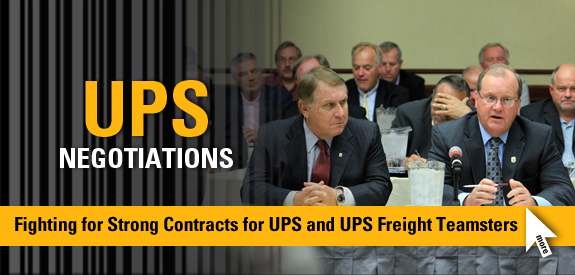
January 17, 2013
Two weeks of negotiations with UPS and UPS Freight wrapped up on Jan. 17 in Washington with progress made on both the UPS and UPS Freight contracts, said General Secretary-Treasurer Ken Hall, Package Division Director.
In UPS Freight negotiations, the UPS Freight National Negotiating Committee has been making steady progress. The Committee addressed seniority and work week issues, as well as protections for medically disqualified drivers.
In UPS negotiations, progress was made on 9.5 language, military leave and stewards’ rights. The UPS National Negotiating Committee began tackling the issue of SurePost, including redirecting more packages to Teamster drivers.
"On the issue of health care, I reiterated that we will fight UPS' outrageous plan to dramatically increase the cost of health care for retirees in company plans," Hall said. "We will not allow the company put the entire burden of health care on the backs of the retirees who made the company what it is today."
UPS has continually complained about health care costs at the bargaining table. Unfortunately, we expect UPS negotiators to propose that Teamsters pay a substantial portion of their monthly premiums for health insurance. We will fight any attempt by the company to raise the cost of health care for actives.
Negotiations for both UPS and UPS Freight are scheduled to resume Jan. 28 in Dallas. For more updates, Click Here
|
|
|
| |
|
Jan 17th 2013 - Negotiations were recessed on Wednesday afternoon. Progress has been proceeding very slowly. The Company continues to seek to undo 50 years of bargaining history and completely rewrite the current agreement by insisting on removing the supplements.
The Company claims that it needs the labor cost savings reflected in its proposal which includes but is not limited to part-timers, split-shifts, and increased use of subcontractors, working across classifications, reduced vacations, and reduction of holidays and the elimination of all supplements. TNFINC has been questioning the purpose and scope of the Company’s proposal. In this regard, TNFINC pointed out that if the Company was truly serious it would have the specific cost savings associated with each of its proposals readily available.
The Company, however, was unable to provide the information and says it will try to provide the information when negotiations resume on January 28. According to TNFINC Co-Chairman Gordon Sweeton “the failure of the Company to have the cost analysis of its specific proposals at its fingertips strongly suggests that the Company was not prepared to engage in legitimate bargaining and that its proposal is simply an overreaching effort designed to bludgeon worker rights.”
In an earlier statement on January 11th, Gordon Sweeton, Co-Chairman of the National ABF Negotiating Committee for TNFINC also said, “We had a rough start this week due to major differences on important issues, but we are hopeful we will make progress in the near future.”
Negotiations will resume next week and are scheduled into March, a full schedule is noted at the bottom of this article. The Teamsters National Freight Industry Negotiating Committee (TNFINC) began negotiations with ABF Tuesday, January 8 in Kansas City, Missouri.
On December 19, TNFINC exchanged national and supplemental contract proposals with ABF. “The union is disappointed with ABF’s initial contract proposals that seek to destroy the NMFA (National Master Freight Agreement) standards that have been in effect for decades and served ABF well,” said Gordon Sweeton, Co-Chairman of the National ABF Negotiating Committee for TNFINC on December 20th. “We hope the company will bargain in a traditional manner so that we can make progress on the important issues from the start,” Sweeton said. “The poor state of the economy over the past four years created losses at all large LTL companies and the labor-intensive type of freight operations ABF conducts are issues as well,” Sweeton added. “As for pensions, the company’s pension costs in its largest fund, the Central States, have been frozen the past two years with health and welfare costs only seeing modest increases during that time as well.”
The current contract expires March 31 for the 7,500 drivers, dockworkers, mechanics and clerical staff. On November 29, leaders from local ABF unions unanimously approved the Teamster’s contract proposals.
The ABF Contract Negotiations Time Table is as follows:
There will 3 straight full weeks of negotiations starting January 7th-11th, January 14th-18th, January 28th-February 1st. One week off and then the talks resume again for 2 more weeks on February 11th-15th, and February 25th-March 1st. Meetings are being held in Kansas City, Mo.
For all the updates and history of the ABF talks Click Here
|
|
|
| |
|
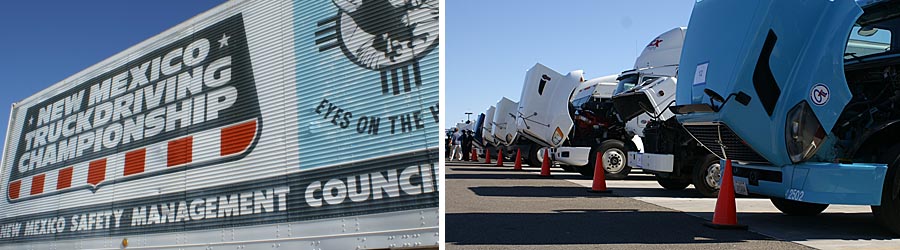
The NM State Truck Driving Championships are April 20th, 2013. They will be held at the FedEx Facility at 7601 Los Volcanes Road in Albuquerque, NM. All companies have deadlines for signing up so make sure you contact you manager and get your application in soon. Let's proudly represent the Teamsters and show the non-union competition Teamster skills.
Click Here for the 2012 results.
|
|
|
| |
|
Don't Delay Rail Yard Remodel
The New Mexican
Mayor David Coss is consistent in his support for labor and working people, whether in his push for the “living wage” or in the suddenly controversial Community Workforce Agreement.
The ordinance, passed unanimously by the City Council in February but delayed in June, has become another point of contention for the often equivocating council. The workforce agreement, which finally took effect Oct. 1, requires workers on city projects that cost more than $500,000 belong to a union. Contractors say they don’t have enough union workers to fill jobs, and that the ordinance will increase costs and send jobs to Albuquerque companies and workers. Alarmed councilors — many of whom voted for the ordinance in the first place — are talking about delaying the measure or repealing it altogether.
Frankly, we are fed up with leaders who can’t hold a consistent position for more than a few months. Councilor Patti Bushee, who is leading the effort to delay or repeal the workforce agreement, voted yes back in February. Also on the council at the time were councilors Carmichael Dominguez, Chris Calvert, Rebecca Wurzburger and Ron Trujillo. If this ordinance is so problematic, we don’t understand why its current opponents didn’t vote against it. New councilors, such as Bill Dimas, Chris Rivera and Peter Ives, can’t be accused of changing horses midstream — they weren’t there to oppose the measure at the outset.
Now, Bushee wants an economic study before moving ahead with the agreement, or even outright repeal. She is proposing a delay to pay $25,000 to The University of New Mexico’s Bureau of Business and Economic Research to study the impact of the ordinance. She even says she has enough councilors on her side to stall the agreement, and perhaps repeal it if necessary. We like Calvert and Ives’ idea, instead. Keep the workforce agreement in place for the time being. A $1.4 million renovation of office space at the Santa Fe Rail yard is going out for bid as soon as December, with a contractor expected to be selected in February and work finished by spring. If it is correct that city contractors will not bid because they don’t hire union labor, we’ll find out. The bidding process should make it clear whether hiring union workers will increase costs — we are not sure why it would, since contractors pay prevailing wages anyway, but let’s find out.
Why do have an agreement in the first place? Union workers bring to the table solid skills and training, with a record of completing work that endures. Local Peter Brill, president of Sarcon Construction Co., has said he hires through construction unions because he likes the workers’ training. He’s not alone, either. In September, Los Alamos National Security LLC and the New Mexico Building and Construction Trades
Council signed a series of labor agreements to cover construction and maintenance work at the Department of Energy and National Security Administration, affecting 750 construction and maintenance workers.
It seems to us, given that this ordinance passed unanimously, that the city should give it a chance — the remodeling job at the Rail yard is a good test project. Put it out to bid, so that the council gets hard data on how the agreement affects construction jobs. If the project fails to attract competitive bids, at that point the city could rethink the agreement. Going forward, perhaps our city councilors can ask harder questions before voting so that they don’t have to revisit issues that passed unanimously. Right now, as Councilor Ives points out; a delay in remodeling office space at the Rail yard could cost the city up to $200,000 in rent (workers will be moving from space in the federal building to the new offices.) By moving ahead with the remodel, the city can see whether the agreement is good for Santa Fe.
|
|
|
|