| |
|
ABF Change Of Operation Will Add More Utility Employees
The IBT Approved the ABF COO that had been previously deadlocked in August of 2011. The Change will add 86 Utility positions in terminals mainly east of us.
This will not affect the New Mexico Teamsters in any way as we are not a part of the change and have never had Utility drivers in this state.
To read the entire COO you can Click Here.
|
Download:
 ABFUtilityEmployeeChangeFeb2012.pdf ABFUtilityEmployeeChangeFeb2012.pdf
|
|
| |
|
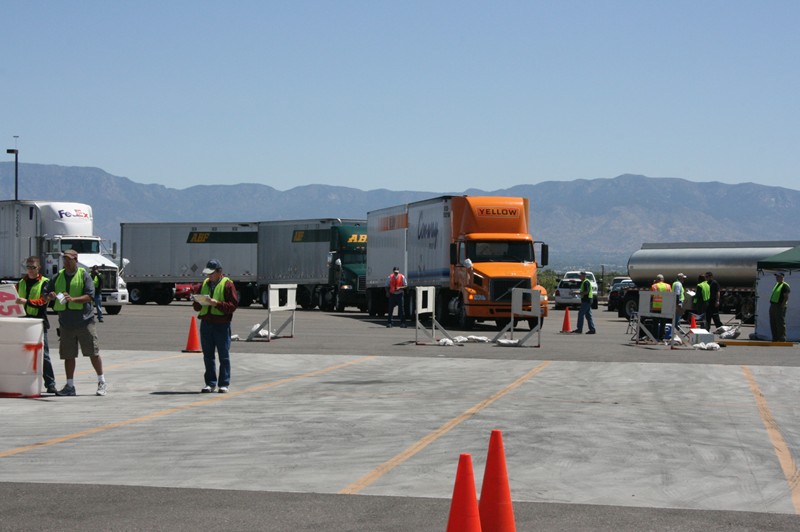
Are You Signed Up For the 2012 NM Truck Roadeo Championships?
Talk to your employer today to find out what you need to do to participate.
The New Mexico Truck Roadeo competition will take place on Saturday, May 5th, 2012 at the FedEx facility located on Los Volcanos, in Albuquerque and the Awards Banquet will take place that evening at the Sheraton Uptown on the corner of Louisiana and Menaul. Look forward to seeing you at both events.
For those of you who will be participating in the New Mexico Truck Driving Championships competition this year, the 2012 State and National Rules and Procedures book and the 2012 Facts for Drivers (used to help study for the Championships Written Exam) will be available in February.
Several rules in the rulebook have been changed and others clarified (for example, some of the time limits for the Pre-trip Inspection have changed); and a number of sections and statistics have been updated or added in the Facts for Drivers.
Get involved, this is a great competition and it is fierce. Think you are one of the best drivers? Show your Union Pride and show those non-union drivers what you can do! Talk to your employer today!
|
|
|
| |
|
More Rest Time Required for Commercial Motor Vehicle Drivers
Posted on January 25, 2012 by Lisa Whittaker on http://www.employerlawreport.com
The United States Department of Transportation ("Department") has issued an Hours-of-Service ("HOS") Final Rule that is meant to reduce the excessively long work hours of Commercial Motor Vehicle ("CMV") drivers. The Department wants to ensure drivers have enough time to obtain adequate rest on a daily and weekly basis, because excessive driving hours increase the risk of fatigue-related crashes and long-term health problems for drivers.
The objective of the final rule is to reduce the acute and chronic fatigue of drivers. The effective date of the final rule is February 27, 2012, and the compliance date of selected provisions is July 1, 2013.
The Federal Motor Carrier Safety Administration ("FMCSA") made several changes to the HOS rule. The three primary changes include:
- Restarts are now limited to one per week;
- Restarts must include 2-night periods between 1:00-5:00 a.m.; and
- Drivers must take a 30-or-more minute break after 8 consecutive hours of driving.
Click Here to read more.
|
Download:
More_Rest_Time_Required_for_CMV_Drivers.pdf
|
|
| |
|

New Name For YRC:
YRC Inc. is changing its name to YRC Freight to better focus attention on its freight services and give employees from the merger of Yellow Corp. and Roadway Corp. a new name to rally behind.
Click Here to read the full story behind the name change.
New Logo For Yellow and Roadway Brands:
YRC Inc., a subsidiary of YRC Worldwide Inc., today officially unveils the launch of its new brand – YRC Freight. The brand was introduced to employees in late January at a company event. In addition to the new name, a new logo, uniforms, equipment and signage will be rolled out across North America.
"We are proudly debuting our new name, YRC Freight. Moving freight is our heritage, what we do best and the key to our future. Our new name, logo and branding program publicly demonstrate the unification of a new company and culture that aligns perfectly with our strategy moving forward," said Jeff Rogers, president of YRC Freight. Click Here to read the full story.
New Mission For YRC Freight:
UPDATE!!! AS OF FEB. 16th THE CHANGE AS OUTLINED BELOW, HAS BEEN REINSTATED, AND IS SCHEDULED TO BE HEARD IN KANSAS CITY MARCH 14-15, 2012.
Network redesign concentrates on long-haul freight, reduced handling
YRC Worldwide is proposing changes to its long-haul freight network that will speed shipments and take long-haul carrier YRC out of the next-day freight market.
The change of operations, which must be approved by the Teamsters union, would be the most significant step yet in the restructuring of YRC launched last year by CEO James Welch and President Jeff Rogers.
“We’re going to have YRC focus on long-haul,” Rogers said in an interview Monday. That means eliminating the next-day Velocity network YRC launched in 2008.
With that decision, the long-haul carrier will no longer compete with sister companies in the YRC regional group for same-day or next-day freight.
“We’ve got Holland, New Penn and Reddaway, the best next-day carriers in their footprint,” Rogers said. “We’re going to let them do what they do best.”
Restructuring its long-haul network will help YRC load more freight direct to more points, reducing the potential for damage, building density and speeding shipments.
“We’re going to eliminate a lot of handling, reduce several thousand handles a day,” said Rogers. “We want to be the best two- to five-day carrier, period."
|
|
|
| |
|

Arkansas Best Corporation announced fourth quarter 2011 earnings of $0.05 per share, compared to a fourth quarter 2010 loss of $0.12 per share. For full year 2011, Arkansas Best's earnings were $0.23 per share versus a loss of $1.30 per share in 2010. These quarterly results include charges for a supplemental pension settlement of $0.03 per share related to a previously disclosed ABF executive retirement effective at the end of 2011.
Click Here to read the full report.
 UPS today announced fourth quarter 2011 adjusted diluted earnings per share of $1.28, a 21% improvement over the prior-year period. Total revenue increased 6% to $14.2 billion and adjusted operating profit climbed 17% to more than $2 billion. UPS today announced fourth quarter 2011 adjusted diluted earnings per share of $1.28, a 21% improvement over the prior-year period. Total revenue increased 6% to $14.2 billion and adjusted operating profit climbed 17% to more than $2 billion.
Last Friday, the company announced a change in pension accounting to a mark-to-market methodology. Adopted in the fourth quarter of 2011 and applied retrospectively, this new method resulted in after-tax charges in 2011 and 2010 of $527 million and $75 million, respectively. Also, in the prior-year period, UPS recorded a net after-tax gain of $32 million from the sale of certain non-core business units in the Supply Chain and Freight segment. On a reported basis, fourth quarter 2011 diluted earnings per share were $0.74, a decline of 28% from the same quarter last year.
For the full year 2011, UPS achieved a new high in adjusted diluted earnings per share at $4.35. On a reported basis, diluted earnings per share were $3.84.
Click Here for the full report.
|
Download:
ABF4Q_11_Earnings_Release.pdf
|
|
| |
|

YRC Change of Operations 2012
UPDATE!!! AS OF FEB. 16th THE CHANGE AS OUTLINED BELOW, HAS BEEN REINSTATED, AND IS SCHEDULED TO BE HEARD IN KANSAS CITY MARCH 14-15, 2012.
January 30, 2012 - The New Proposed COO is scheduled to be heard IN KANSAS CITY MARCH 14-15, 2012. According to the company, they are requesting the COO to "restructure the company's Road Domicile locations, Distribution Center locations and Corridor Hub Terminal locations to reduce freight handling and allow YRC to return to what it does best, providing world class service to its customers in the 500-3500 mile market." They are also requesting to "eliminate the entire Velocity Network & Utility Employees in the network..."
Here in New Mexico, AQE would be gaining 13 road drivers and one Dock position under the proposed change. Below are some documents you may be interested in:
Read the Service Restructuring Plan COO Here
Read the Letter from YRC to Hoffa Here
Read the Utility COO Here
Read the Correction/ Addendum's Here
Click Here To Visit The YRC Updates Page
|
|
|
| |
|
YRC, Teamsters to Discuss Operations Changes
William B. Cassidy, Senior Editor | Jan 7, 2012 2:48PM GMT
The Journal of Commerce Online - News Story
New talks could encompass truck terminals, freight handling procedures.
YRC, looking to restructure its operations as the trucking operator seeks to rebuild its finances, is preparing for talks with the Teamsters union on a redesign of its freight terminal network and how its union employees handle shipments.
The redesign is the next step in a restructuring at the nation’s third-largest less-than-truckload carrier started last year by new YRC President Jeff Rogers. It’s part of a broader overhaul of the YRC Worldwide business that’s taken place since a financial rescue that included critical concessions from the Teamsters.
YRC managers will meet with union officials after completing a review of the troubled carrier’s network, Rogers said in an interview Friday.
“We’ve got meetings set up already,” he said. “I sat down with Tyson (Johnson) within my first couple of weeks as president and told him it would be coming.”
YRC Worldwide named Rogers president of its core long-haul LTL subsidiary last September after completing a $500 million financial restructuring. Johnson is the Teamsters National Freight Director and an international vice president.
The long-haul LTL operator lost more than $1.6 billion as its parent company’s revenue tumbled from nearly $10 billion in 2006 to $4.3 billion in 2010.
YRC Worldwide merged Roadway with Yellow Transportation in 2009, six years after Yellow bought Roadway for $1.1 billion. “We’re moving forward as YRC, not Yellow, not Roadway,” Rogers said. “Those companies don’t exist anymore. One of the biggest tasks ahead for me is to bring the Yellow and Roadway folks together.”
The company is considering whether further consolidation is needed, but Rogers said he wants to eliminate some freight handling.
“We need to look at the way we’re moving freight through distribution centers,” Rogers said. That could require Teamster approval for a change of operations.
Last fall, Rogers said YRC is handling “too much freight too many times,” which can drive up costs, slow shipments and risk higher claims. Changing the operations, however, is complicated by contractual work rules.
Rogers said there are steps YRC can take to reduce freight handling before a change of operations, such as making sure terminals adhere to load plans.
Rogers already has streamlined the $2.9 billion company’s management and consolidated the carrier’s operating territories into two regions.
He said the company is making progress toward returning to profitability, supported by freight volumes that remained “relatively strong” through Dec. 23.
“I’m encouraged with how the year ended,” he said. “That tells me 2012 could be a very good year."
|
|
|
| |
|
U.S. Transportation Secretary Ray LaHood today announced a final rule that employs the latest research in driver fatigue to make sure truck drivers can get the rest they need to operate safely when on the road. The new rule by the U.S. Department of Transportation's Federal Motor Carrier Safety Administration (FMCSA) revises the hours-of-service (HOS) safety requirements for commercial truck drivers.
"Trucking is a difficult job, and a big rig can be deadly when a driver is tired and overworked," said Transportation Secretary Ray LaHood. "This final rule will help prevent fatigue-related truck crashes and save lives. Truck drivers deserve a work environment that allows them to perform their jobs safely."
As part of the HOS rulemaking process, FMCSA held six public listening sessions across the country and encouraged safety advocates, drivers, truck company owners, law enforcement and the public to share their input on HOS requirements. The listening sessions were live webcast on the FMCSA Web site, allowing a broad cross-section of individuals to participate in the development of this safety-critical rule.
"This final rule is the culmination of the most extensive and transparent public outreach effort in our agency's history," said FMCSA Administrator Anne S. Ferro. "With robust input from all areas of the trucking community, coupled with the latest scientific research, we carefully crafted a rule acknowledging that when truckers are rested, alert and focused on safety, it makes our roadways safer."
FMCSA's new HOS final rule reduces by 12 hours the maximum number of hours a truck driver can work within a week. Under the old rule, truck drivers could work on average up to 82 hours within a seven-day period. The new HOS final rule limits a driver's work week to 70 hours.
In addition, truck drivers cannot drive after working eight hours without first taking a break of at least 30 minutes. Drivers can take the 30-minute break whenever they need rest during the eight-hour window.
The final rule retains the current 11-hour daily driving limit. FMCSA will continue to conduct data analysis and research to further examine any risks associated with the 11 hours of driving time.
The rule requires truck drivers who maximize their weekly work hours to take at least two nights' rest when their 24-hour body clock demands sleep the most - from 1:00 a.m. to 5:00 a.m. This rest requirement is part of the rule's "34-hour restart" provision that allows drivers to restart the clock on their work week by taking at least 34 consecutive hours off-duty. The final rule allows drivers to use the restart provision only once during a seven-day period.
Companies and drivers that commit egregious violations of the rule could face the maximum penalties for each offense. Trucking companies that allow drivers to exceed the 11-hour driving limit by 3 or more hours could be fined $11,000 per offense, and the drivers themselves could face civil penalties of up to $2,750 for each offense.
Commercial truck drivers and companies must comply with the HOS final rule by July 1, 2013. The rule is being sent to the Federal Register today and is currently available on FMCSA's Web site at http://www.fmcsa.dot.gov/HOSFinalRule.
Article by Freight Teamsters Blogspot http://freightteamsters.blogspot.com/2011/12/us-department-of-transportation-takes.html
|
|
|
| |
|
Restricting the Use of Cellular Phones Jan 3rd
On November 23rd, 2011 the Federal Motor Carrier Safety Administration (FMCSA) and Pipeline Hazardous Materials Safety Administration (PHMSA) issued a final rule amending the Federal Motor Carrier Safety Regulations (FMCSRs) and the Hazardous Materials Regulations (HMRs). This rule was issued to improve safety by reducing the frequency of distracted driving-related crashes, fatalities, and injuries involving drivers of commercial motor vehicles (CMVs). The Agencies also amended their regulations to implement new driver disqualification sanctions for drivers of CMVs who fail to comply with the Federal restriction and new driver disqualification sanctions for commercial driver’s license (CDL) holders who have multiple convictions for violating a State or local law ordinance on motor vehicle traffic control that restricts the use of hand-held mobile telephones. Additionally, motor carriers are prohibited from requiring or allowing drivers of CMVs to use mobile, hand-held telephones while operating CMVs. The Final Rule becomes effective January 3rd, 2012.
|
Q: Is Push-to-Talk allowed?
|
|
A: No. A driver’s use of the Push-to-Talk function on a mobile telephone violates the prohibition against holding the phone. This includes the continuous holding of a button that is necessary to use a Push-to-Talk feature through a mobile telephone, even when the driver is using a connected microphone or wireless earphone.
|
Click Here To Read More Including a Q&A
Read the 66 page Law with Explanations Here (Highlighted Text)
|
Download:
Restricted_Cellphone_Use.pdf
,
Mobile_Phone_Ban_With_Highlights.pdf
|
|
|